Renault-Nissan, Daimler In
Small-Car Alliance
BRUSSELS - Will a mini Mercedes powered by a
Renault-Nissan engine still command a
luxury-brand premium? Daimler AG is
confident it will, as the German automaker
teams up with France's Renault and Japan's
Nissan to share parts and platforms and make
more cost-efficient and competitive small
cars, forming an automotive three-way
alliance that they hope will help them ride
out a sales slump.
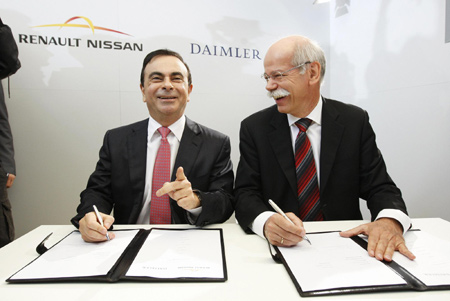
Dieter Zetsche (R), CEO of German car
manufacturer Daimler AGs with
Carlos Ghosn (L), chief executive officer of
Renault-Nissan Alliance,
sign an agreement in Brussels April 7, 2010.
Carmakers Renault SA ,
Nissan Motor Co and Daimler AG announced on
Wednesday a
strategic cooperation that includes a
one-time exchange of minor
stakes in each other.
The car makers aim to strip out billions of
euros (dollars) in costs over the next five
years by sharing parts and development
costs, mainly in energy efficient compact
cars such as the Renault Twingo and the
Mercedes Smart car.
Analysts say there is little risk that the
cachet of Mercedes' flagship brand will take
hit from the deal, as the parts sharing will
be limited to the small car division.
The risk of brand contamination for
Daimler's Mercedes is "practically zero,"
said Juergen Pieper, an analyst at Metzler
Equities in Frankfurt, pointing to
Volkswagen AG's stewardship of the
high-priced Bentley brand.
"Bentley is practically 70 percent Audi, and
do the people who spend euro200,000 for a
Bentley think about that? No, I don't think
so," he said. "It's really touching only
small cars and this is not a sensitive part
of the group."
Helmut Becker, an economist at Germany's IWK
think tank said customers "probably won't
notice much" in Daimler's smaller model
ranges, the A-Class and B-Class.
"It remains a Daimler car ... there is no
mixing-up in the product lineup, and it will
happen under the hood," he said.
Top executives from Renault and Daimler also
took pains to stress that their brands would
keep their separate identities, even if the
engines that power the cars start to look
more and more alike.
"Each brand has its own identity and its own
kind of products and its own cost and price
level," Renault boss Carlos Ghosn said. "We
need to keep each brand very different from
the others."
Ghosn said the companies had quizzed
customers of Nissan's luxury brand Infiniti
vehicles and Mercedes and believed that
sharing engines would not cannibalize sales
of either.
"People buying Infiniti or Daimler, they
don't cross-shop between the two brands," he
said. Infiniti buyers show interest in
Lexus, Audi and BMW "but very little in
Mercedes. We came to the conclusion that
Mercedes collaborating with Infiniti will
not be hurting each other," he said.
The partnership comes amid a painful
industry wide slump and will focus on
sharing the development and production of
chassis and engines. The move will be sealed
with a cross-shareholding giving the three
companies a small, symbolic stake in each
other.
Speaking at a joint news conference
Wednesday in Brussels, Daimler boss Dieter
Zetsche cited rising demand for small cars
as a key driver behind the alliance.
"Since the small and compact vehicle segment
is so highly competitive and price sensitive
we also need to have the right cost
structure," Zetsche said.
Government cash-for-clunkers programs and
customer concerns over fluctuating fuel
prices have helped push sales of smaller
cars over heavier gas guzzlers and luxury
models.
Cooperation will include developing a common
chassis for two of the automakers' small
cars, Daimler's Smart Fortwo and Renault's
Twingo. The partnership will also extend to
sharing gasoline and diesel engines, with
Daimler's Mercedes-Benz using Renault-Nissan
engines for its future lineup of premium
compact cars, and Nissan's Infiniti using 4-
and 6- cylinder engines from Daimler, the
companies said.
"Right away we are strengthening our
competitiveness in the small and compact car
segment and are reducing our CO2 footprint _
both on a long-term basis," Zetsche said.
Zetsche said the partners "will work
together to examine further possible areas
of cooperation" beyond those detailed
Wednesday.
Renault Chief Executive Carlos Ghosn said
European Union restrictions on cars' average
carbon dioxide emissions _ achieved by lower
fuel consumption _ was also a factor in the
deal. Companies could face fines if they
don't gradually reduce CO2 output after
2012.
Small cars are less profitable and sharing
parts and platforms allows the companies to
build them more cheaply.
The executives estimated that the
Renault-Nissan alliance and Daimler would
each achieve euro2 billion ($2.7 billion) in
cost savings and additional sales from the
new alliance over the first five years. The
savings will be made through sharing of
production and development costs as well as
economies of scale through some joint
purchasing, the companies said _ and not
through layoffs.
Renault's Ghosn, who also heads Japan's
Nissan, said the alliance was just the
latest step in a wave of industry tie-ups
for Renault and others.
"The name of the game is to be present
everywhere," Ghosn said, "so we are going to
move for more and more consolidation."
"Do not be surprised if we continue to add
scale," he said.
Renault and Nissan will each take on a 1.55
percent stake in Daimler, which in turn will
take a 3.1 percent stake in each of the
other two.
The move will add to Renault and Nissan's
existing 11-year-old alliance, that has made
it the world's fourth largest automotive
group with sales of 6.1 million vehicles
last year. They share development costs and
Renault owns a 44 percent stake in Nissan.
Ghosn said Renault and Nissan's cooperation
with Daimler could also eventually see them
share technology for electric cars and
batteries. He has been a vocal proponent of
electric vehicles and predicts the segment
will grow to about 10 percent of global
sales by 2020.
Other automakers _ including Chrysler,
Mitsubishi and Ford _ are also touting plans
for cars with electric motors as the
industry seeks to overcome the current sales
slump and meet tougher environmental and
carbon emission standards.
Daimler's boss ruled out any possibility
that the deal with Renault and Nissan could
evolve into a full merger like the stormy
marriage it had with Chrysler from 1998 to
2007.
"At this point in time there is no thought
of going further," Zetsche said.
The Wednesday deal is the car makers'
response to a sharp sales downturn as
recession-hit consumers shunned spending on
big-ticket items. Last year Renault made its
first annual loss since it was privatized 13
years ago. It predicts another tough year in
2010.
Daimler, which relies heavily on costly
luxury cars likes its Mercedes, lost euro2.6
billion last year after taking charges
including euro294 million to settle its exit
from a failed alliance with Chrysler LLC ,
Renault shares were trading down 1.75
percent at euro36.22 in Paris late morning
trading. Daimler shares were down 0.2
percent at euro35.44.
|
|
|
 |
|
|
|
|
|


