Costa
Rica's
Irazú
In
Aid
Of
Olympic
Dream
Chasing
the
Olympic
dream
can
take
athletes
to
many
unique
places.
For
Manuel
“Manny”
Huerta,
an
American
triathlete
hoping
to
qualify
for
the
London
2012
Games,
it
put
him
on
Irazu,
an
active
volcano
in
Costa
Rica.
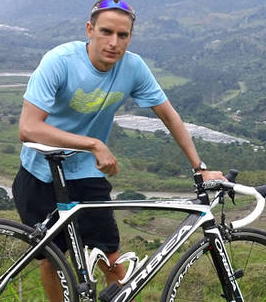
Manny Huerta at his unique
training home - Irazu
volcano in Costa Rica. |
Huerta’s
Olympic
journey
started
in
Cuba,
where,
as a
young
boy,
he
watched
the
Games
on
state-run
television.
He
also
became
an
avid
swimmer
and
runner,
but
his
opportunities
were
limited
under
the
communist
regime.
“Being
born
in a
communist
country,
if
you
are
not
with
the
government,
you
have
very
little
chance
of
having
any
type
of
success,”
Huerta
said.
The
stakes
changed
in
1997,
when
he
fled
with
his
mother
and
sister
to
Miami
as
political
refugees.
Once
they
had
settled
in
the
United
States,
Huerta
continued
swimming
and
running
before
joining
a
group
that
provided
sports
equipment
to
inner-city
youths.
Then,
at
age
15,
he
developed
a
new
fascination
—
the
triathlon.
“At
first
it
was
to
stay
in
shape
for
the
upcoming
swimming
and
cross-country
seasons,”
Huerta
said.
But
as
he
got
better
at
triathlons,
he
realized
he
was
better
at
it
on a
national
level
than
he
was
at
swimming
or
running.
So
he
turned
his
full
attention
to
the
triathlon
in
2005.
And,
now
that
he
was
in
America,
Huerta’s
hard
work
was
rewarded:
It
got
him
a
cross-country
scholarship
from
Florida
Atlantic
University
and
then
a
spot
on
USA
Triathlon
Project
2012,
a
program
to
identify
top
athletes
who
potentially
could
achieve
international
success.
Results
soon
followed,
as
Huerta
won
the
2006
USA
Triathlon
Under-23
National
Championship.
As
part
of
the
Project
2012
program,
he
was
invited
to
live
and
train
at
the
US
Olympic
Center
in
Colorado
Springs,
Colo.,
where
he
was
introduced
to
altitude.
He
was
at
the
USOC
facility
only
from
2005
to
’08,
but
he
took
a
liking
to
living
and
training
at
altitude.
So
in
2010,
he
took
up
an
offer
from
a
fellow
triathlete
–
Costa
Rican
Leonardo
Chacon
and
his
trainer,
Roberto
Solano
– to
train
with
them.
And
live
on
an
active
volcano.
It
sounded
like
a
zany
idea,
but
Huerta
quickly
learned
that
by
staying
at
the
volcano
—
it’s
7,000
feet
above
sea
level
— 21
days
at a
time
before
a
major
event
gave
him
a
performance
boost.
“My
hemoglobin
and
hematocrit
levels
get
higher
—
those
are
the
cells
that
carry
oxygen
to
your
body,”
Huerta
explained.
“(Living
at
altitude
helps)
produce
a
better
red
blood
cell.”
So,
before
major
competitions
such
as
the
International
Triathlon
Union
event
in
San
Diego
this
weekend,
Huerta
trains
in a
Costa
Rican
village
at
an
elevation
of
4,000
feet
before
changing
his
routine
for
the
final
21
days.
At
that
point,
after
a
day
of
training
in
and
around
the
village,
he
will
make
a
25-minute
drive
up
Irazu
Volcano
to
get
a
good
night’s
sleep.
The
next
day,
he
will
return
to
town
for
more
training.
“I
think
that
my
performance
has
gotten
a
lot
better
(over)
the
past
two
years,”
Huerta
said.
Outcomes
indicate
he
is
correct.
Last
year,
he
claimed
silver
during
the
Pan
American
Games
in
Mexico
and
was
the
top
American
male
performer
at
the
London
and
Kitzbuhel
(Austria)
World
Championship
Series,
all
of
which
earned
him
2011
Elite
Athlete
honors
from
USA
Triathlon.
He
hopes
for
similar
success
this
weekend
in
San
Diego.
Barring
a
drastic
change
in
the
standings,
the
USA
men
will
have
only
two
spots
for
London
2012.
The
top
American
finisher
this
weekend
will
receive
one
of
those
berths;
if
two
Americans
were
to
finish
in
the
top
nine
in
San
Diego,
they
would
both
get
a
spot.
Otherwise,
any
remaining
spots
will
be
filled
by a
discretionary
selection
by
the
USA
Triathlon
Elite
Athlete
Selection
Committee.
With
so
much
on
the
line,
Huerta
feels
confident.
“I
feel
very
good
and
positive,
I
think
I
have
a
very
good
chance
at
trials
since
I
know
(I
am)
at
my
peak
fitness,”
said
Huerta.
Success
this
weekend
means
more
than
the
realization
of a
dream
born
in
Cuba.
It
also
would
be
Huerta’s
way
of
saying
thank
you
to
his
adopted
country
for
all
it
has
bestowed
on
him
and
his
family.
“It’s
a
dream
come
true
and
it’s
something
that
will
pay
off
all
the
sacrifices
that
my
family
and
I
have
made
coming
over
to
the
US,”
Huerta
said.
“It
will
feel
like
payback
to
the
US
itself
–
telling
them
I
was
born
in a
small
communist
Island
yet
here
I
am,
I am
a
hard
worker
and
I
made
it
all
the
way
to
the
biggest
sporting
event.
“I
think
I
can
also
motivate
a
lot
of
young
Hispanic
kids
that
come
to
this
country
and
show
them
that
if
you
do
work
hard
here,
your
dreams
will
come
true.”
That’s
worth
staying
on
an
active
volcano.


