Web 3.0 Explained
We are sure a lot of you out there have
heard the term Web 2.0, but today we explain
Web 3.0. Web 3.0 is a very interesting term
that talks about the semantic web.
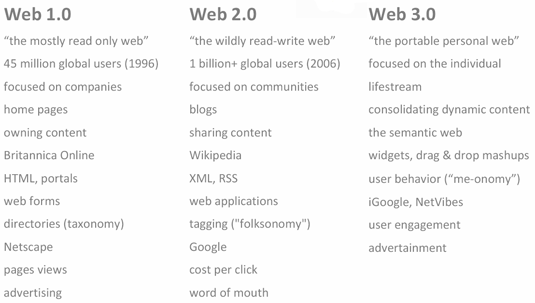
This image better explains the differences
between Web 1.0, Web 2.0 and Web 3.0.
Web 1.0 – Web 1.0 was all about static
content which was read-only. Best examples
of web 1.0 was geocities and hotmail, which
both have great static html websites with
read-only content. People preferred
navigating the web through link directories
of Yahoo! and dmoz.
Web 2.0 – Web 2.0 is about user generated
content and the read-write web. People are
consuming as well as contributing
information through blogs or sites like
Flickr, YouTube, Digg, etc. The line
dividing a consumer and content publisher is
increasingly getting blurred in the Web 2.0
era.
Web 3.0 – This will be about semantic web
(or the meaning of data), personalization
(e.g. iGoogle), intelligent search and
behavioral advertising among other things.
If that sounds confusing, try this:
The Semantic Web is an evolving
development of the World Wide Web in which
the meaning (semantics) of information and
services on the web is defined, making it
possible for the web to "understand" and
satisfy the requests of people and machines
to use the web content.
Humans are capable of using the Web to carry
out tasks such as finding the Finnish word
for "fish", reserving a library book, and
searching for a low price for a DVD.
However, one computer cannot accomplish all
of these tasks without human direction,
because web pages are designed to be read by
people, not machines.
The semantic web is a vision of information
that is understandable by computers, so
computers can perform more of the tedious
work involved in finding, combining, and
acting upon information on the web.
|
|
|
 |
|
|
|
|
|


