Nicaragua - Colombia
Spat Could Affect Costa Rica, Foreign
Ministry Says
The Costa Rican Foreign Ministry has filed a
motion with the International Court of
Justice (ICJ) or World Court to be
allowed to intervene, without being a party
to the process, in the Nicaragua and
Colombia conflict over the San Andrés island
in the Caribbean.
Although Costa Rica does not have a stake in
the dog fight between the neighbouring
nations, it is concerned that a court
decision to decide the future of the island
may affect Costa Rica.
The motion was presdent by vice-canciller,
Edgar Ugalde, to the Phillippe Courvreur,
secretary of the international court.
According to the Costa Rican Ministerio de
Relaciones Exteriores any change to the
documents filed by the governments of
Nicaragua and Colombia, albeit the smallest
of change, could affect the interests of
Costa Rica and thus should be allowed to
participate in the process.
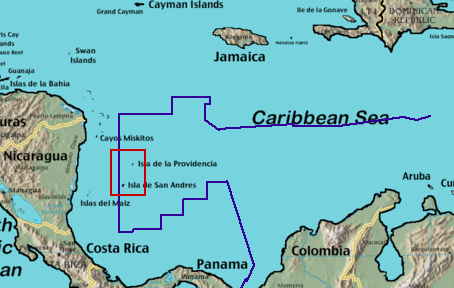
At question in the dispute between Nicaragua
and Colombia is maritime territorial limits.
Any changes to those limits could affect
Costa Rican interets, the foreign ministry
argues.
Territorial disputes of Nicaragua include
the territorial dispute with Colombia over
the Archipelago de San Andres y Providencia,
which is one of the departments of Colombia,
consisting of two island groups about 775 km
(480 miles) northwest of Colombia and 220 km
(140 miles) from the coast of Nicaragua, and
eight outlying banks and reefs.
After gaining its independence, the Republic
of Gran Colombia occupied the islands in
1822 and transferred control over them to
the department of Magdalena. Subsequently,
the United Provinces of Central America (UPCA)
did not recognize the occupation of the
islands and claimed ownership over them,
while Colombia in turn protested the UPCA's
occupation of the eastern coast of modern
day Nicaragua. The UPCA federation dissolved
in civil war between 1838-1840 and the
resulting state of Nicaragua carried on with
the dispute, as did the Republic of the New
Granada (made up of modern Colombia and
Panama) that emerged from the dissolution of
Gran Colombia.
Colombia later established a local
administration ("intendencia") in the
islands during 1912. The signing of the
Esguerra-Bárcenas treaty in 1928 between
both governments temporarily resolved the
dispute in favor of Colombia.
However, since 1980, when the Sandinista
government assumed power in Nicaragua, a
constitutional reform was enacted and the
treaty was renounced.
Nicaraguans claim that the treaty was signed
under United States pressure and military
occupation and thus does not constitute a
sovereign decision, while Colombia argues
that the treaty's final ratification in
1930, when U.S. forces were already on their
way out, confirms its validity.
In 2001 Nicaragua filed claims with the
International Court of Justice (ICJ) over
the disputed maritime boundary involving
50,000 km² in the Caribbean, which includes
the islands of San Andrés and Providencia.
Colombia has claimed that the ICJ has no
jurisdiction over the matter and has
increased its naval and police presence in
the islands. It has also prepared the legal
defense of its case that will be presented
before the tribunal.
In a preliminary decision the Court has
sided with Colombia on the question of
sovereignty over the Islands (47 km²) but
has agreed with Nicaragua that the rest of
the maritime accidents is yet to be assigned
according to the law of the sea and that the
82nd meridian is in no way a maritime
border. the Court is competent to set that
border and will do it in the final verdict
of the dispute.
In addition, Colombia and Honduras signed a
maritime boundary treaty in 1999 which
implicitly accepts Colombian sovereignty
over the islands. It should be noted that
the Court settled the dispute in favor of
Nicaragua thus dealing a blow to the
Colombian master plan over the Caribbean
maritime border.
 |
|
|
 |
|
| |
|
|
|
|
|


