Decades Old Dream
Becomes Reality This Week With The Opening
Of The San José - Caldera Highway
This coming week will be a dream come true
for many Costa Ricans, a dream that has
taken more than 30 years and many
administrations to make a reality. We are
talking about the San José - Caldera route,
a road of decades in the making, that
officially opens on Wednesday, January 27.
The new rout will shave off at least 45
minutes or more from all destinations to and
from the Pacific coast.
The idea began in the late 70's when it was
first proposed to cut a route through the
mountains of Puriscal and Atenas to the get
to the Pacific ocean in less than an hour.
The new highway not only does that, but
makes the drive even pleasant.
Currently, to reach the Pacific coast of
Caldera/Puntarenas there are two main
routes: the Interamericana and the "Aguacate".
Both routes mean climbing to the summit of a
mountain and then dropping to sea level.
Both routes are only two lane highways that
are clogged with heavy truck and bus
traffic, with the average speed climbing and
descending the mountains of between 30 km/h
and 50 km/h, and requiring the heavy use of
brakes and/or engine compression to slow
down the steep descent, especially that of
the Aguacate.
The new road cuts through the valley and
with speeds of between 80 km/h and 100 km/h,
depending on the section and with no steep
hills or mountains to climb or descend.
Lets take a look at the time involved to get
to Playa Jacó or Puntarenas.
From the Juan Santamaría (San José) airport
to Orotina, weaving through La Garita,
Atenas and up and over the Desmonte (cerros
del Aguacate) to Orotina, it takes 75
minutes ( 1 hour and 15 minutes for those on
analog time) and then 30 minutes from
Orotina to Jacó.
To Puntarenas, from the Santamaría the route
on the Interamericana passing Grecia,
Naranjo, Palmares and San Ramón is 90
minutes to Barranca and then 5 - 10 minutes
more to Puntarenas, for a total trip time of
just under two hours. Alternatively, one can
use the Aguacate, but the time remains the
same.
These times are based on fluid traffic
conditions. Add tens of minutes for heavy
traffic and lots of heavy trucks and buses
and up to hours in the event of an accident.
On the new route, Santa Ana (Piedades) to
Orotina takes only 17 minutes, with no
mountains or hills to climb. So, to Jacó or
Puntarenas, the total time is 47 minutes.
The new route will be expensive for some, as
it is a toll road. The total cost, one way
from San José to Orotina is ¢1.930 colones
for a light passenger vehicle. Buses, mini
vans and heavy trucks will pay double or
more. The cost of using the Interamericana
is only ¢150 colones (toll paid only en
route to San José) and ¢480 each way to Jacó/Caldera.
The tolls are at Escazú, San Rafael de
Alajuela, Atenas and Pozón. For the time
being the tolls at La Guacima and Cuidad
Colón (Piedades de Santa Ana) will not be
charged as yet, as the government decides on
an action following complaints of local
residents.
In addition to those two destinations
points, destinations like Quepos/Manuel
Antonio will be under 2 hours, Liberia will
be only 2 1/2 hours, and take off 45 minutes
from any of the Guanacaste beach
destinations.
Although the new road opens in a few days,
there is still much to complete.
The 40 kilometre route between Santa Ana and
Orotina still has no services like gasoline
stations, hotels, sodas or restaurants.
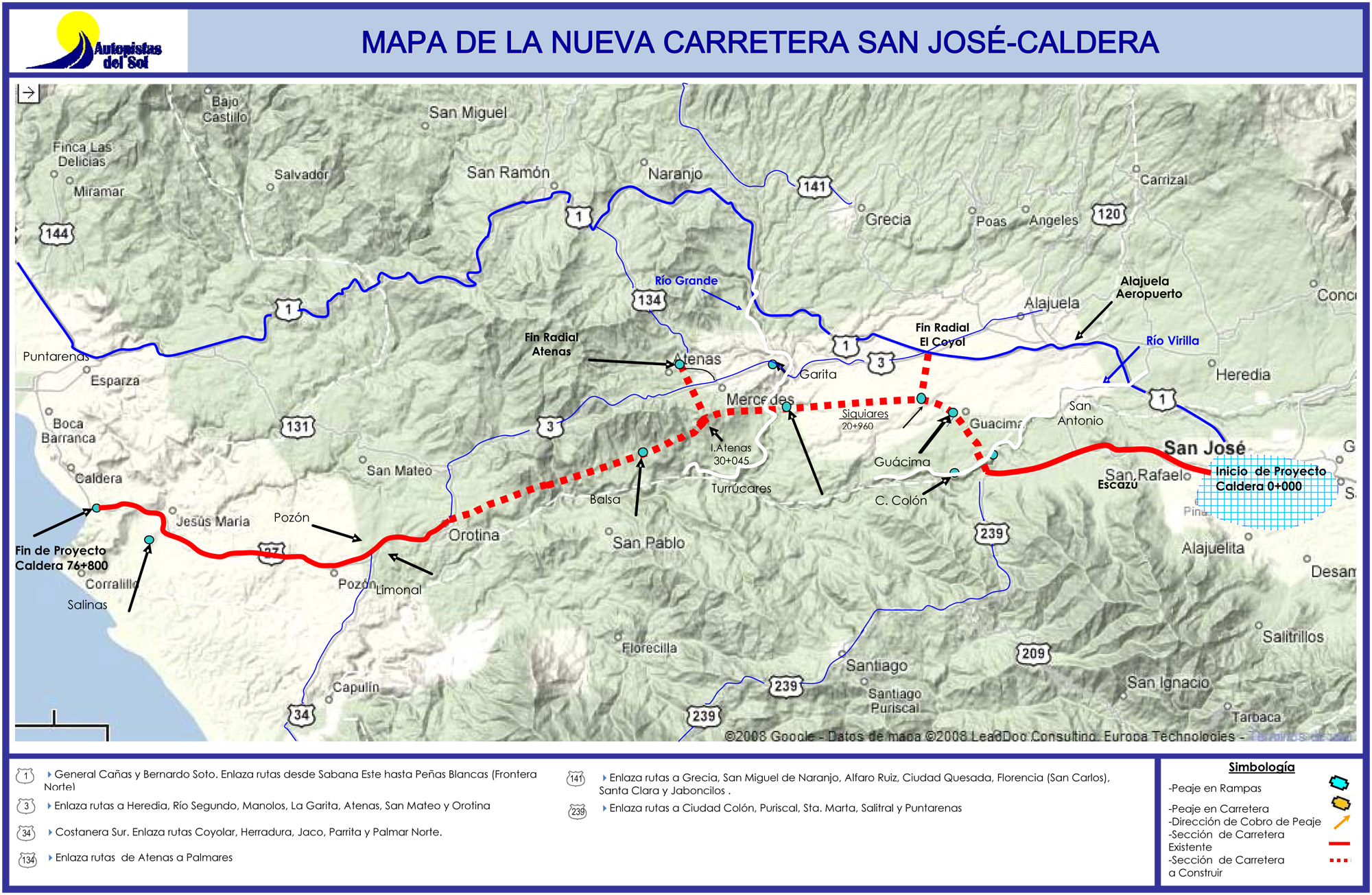
Click on map to
enlarge |
|
|
|
|
| |
|
|
|
|
|


