My, What Scary
Eyes You Have
To keep from
being eaten,
animals have
evolved
countless ways
to scare off
predators. But
what to do if
you're a small,
slow-moving
creature like
the caterpillar
that isn't
particularly
scary?
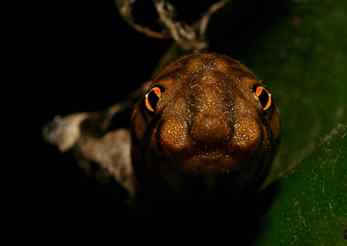
The caterpillar of a skipper butterfly has "eye" markings. [Foto: Daniel H
Janzen
Try looking like
something that
is.
Hundreds of
varieties of
caterpillars
accomplish this
feat with
special markings
that resemble
eyes, according
to University of
Pennsylvania
biologists
working in Costa
Rica.
The eye-like
spots look
enough like the
real thing that
birds and other
would-be
predators back
off quickly,
mistakenly
thinking that
the "eyes"
belong to a
larger creature
that could turn
predator into
prey.
Drawing on
decades of
observation, the
biologists argue
that birds are
born with the
tendency to
react this way.
There are so
many different
types of
caterpillars
with eye spots
that a bird
wouldn't be able
to learn by
experience, says
Penn's Daniel H.
Janzen, lead
author of a new
paper in
Proceedings of
the National
Academy of
Sciences.
"If you have to
learn that,
you're dead," he
says.
He wrote the
paper with his
wife, Penn
biologist Winnie
Hallwachs, and
John M. Burns of
the Smithsonian
Institution.
Though such
caterpillars
have evolved a
way to scare off
predators, they
and their
forest-mates are
facing another
threat: humans.
Much of the
forest in the
region where the
biologists work,
in northwestern
Costa Rica, has
been cleared for
farming and
ranching. So in
addition to his
role as
biologist,
Janzen has
become an
advocate for
enlarging a
national park
called Area de
Conservación
Guanacaste.
Donations for
additional land
purchases can be
made to the
Guanacaste Dry
Forest
Conservation
Fund at
http://janzen.sas.upenn.edu/saveit.html.
Read more:
http://www.philly.com/inquirer/health_science/weekly/20100621_My__what_scary_eyes_you_have.html#ixzz0rUbfZFQ4
Watch sports
videos you won't
find anywhere
else
|
|
|
 |
|
|
|
|
|


