Nicaraguan 'Cuatro Leches'
Cake
By Elena Ferretti - FOXNews.com
Tres leches – Spanish for “three milks” – is
a sponge cake soaked in condensed milk,
evaporated milk, heavy cream and topped with
Italian meringue that is so popular across
Latin America it’s become difficult to
pinpoint its origin. “Every Central and
South American country claims it as its
own,” explains Carlos Somoza, who handles
marketing for Cuatro Leches Bakery in Miami.
“We’re Nicaraguan, so of course we claim
it’s Nicaraguan,” he laughs. “But in Miami,
we are the ones who made it famous.”
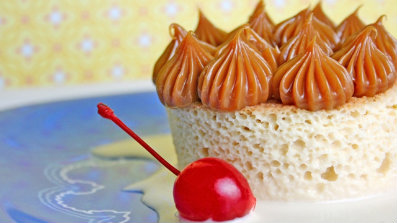
Cuatro Leches Bakery
Tres leches’ milky base might make you think
it’s more of a pudding than a cake, but it’s
not. “A good tres leches holds the shape,
retains the form and holds the three milks.
It is a cake,” says Carlos’ father, Luis.
The evaporated and condensed milks used in
tres leches were created in the
pre-refrigeration 1900s when drinking milk
could be like playing Russian roulette, as
one sip could deliver a fatal dose of
tuberculosis, typhoid or salmonella
bacteria.
Texas pioneer and inventor Gail Borden
created condensed milk in the 1850s. He used
heat to remove 60% of the moisture and added
up to 45% sugar-content that inhibited
bacterial growth and made further
sterilization unnecessary. It was
shelf-stable, posed zero health risk and was
actually used for field rations in the Civil
War and World War I.
Evaporated milk also has 60% moisture
removal and is pasteurized, but it is also
homogenized, vitamin-fortified and
sterilized with the high heat caramelizing
the milk’s natural sugars and turning it
light brown. It’s used primarily as a
substitute for fresh milk. Condensed milk is
used in pies, meringues, puddings, bar
cookies, caramel candies and is poured into
coffee or tea in parts of Asia and Europe.
They’re such radically different products
that confusing the two will wreck a recipe
unless it’s tres leches which is abundant in
both, as well as heavy cream. It was one of
the richest desserts around until Luis
created Cuatro Leches.
In 1999 Luis went back to Nicaragua for the
first time in 20 years and tasted pound cake
frosted with dulce de leche, a kind of Latin
American caramel made by boiling condensed
milk. “I just had this thought to put it on
top of our tres leches instead of Italian
meringue. We tried it. The bakery staff
loved it, the clients loved it. We couldn’t
come up with a name so it became Cuatro
Leches.”
It’s another contribution to Miami’s Latino
culinary community, says Luis.
“Every immigrant wave brings something new.
We brought tres leches and pio quinto,” the
latter a creamy Nicaraguan parfait.
“Guatemalans, Cubans, Salvadorans, each wave
enriches our lives and you see people in a
different light. You’re humanized by the
daily contact.” Luis’ history is unique
among Miami’s immigrants.
The Somozas were the first family of
Nicaragua for the better part of the last
century. Luis’s grandfather Anastasio Somoza
Garcia was president from 1937 to 1957 as
were his uncles, Luis Somoza Debayle, 1956
to 1963 and Anastasio Somoza Debayle,
deposed by left-wing Sandinista rebels in
1979.
Luis is gracious to those who speak kindly
of his family as well as to those who
disparage it. “When we went back in 1999 it
was like walking into a ghost country. Did
you ever read [Isabel] Allende’s ‘House of
the Spirits’ or [Gabriel Garcia] Marquez’s
‘One Hundred Years of Solitude?’ It was like
that. Everything was the same, but at the
same time, not.” The trip conjured up
bittersweet memories. “We never thought our
family would live in the United States. But,
then, most immigrants don’t think that
either,” he muses.
When they arrived in 1979 his brothers
created a Miami version of a Managua’s most
popular steakhouse, Los Ranchos. Luis’
mother, Leonor, began baking tres leches for
the restaurant. Thirty years later the
bakery supplies desserts to more than 40
Miami-area restaurants as well as to three
Los Ranchos.
“Los Ranchos was the first white-tablecloth,
European-style steakhouse in Miami,” says
Luis, “European in its attention to detail.”
Everyone from Jeb Bush to former astronauts
to local and national politicians dined
there, he says. The Iran-Contra scandal made
the restaurant a magnet for the media who
consistently used it as a live-shot
location. The media “decided that dark
capers were going on there,” says Luis. “It
was ridiculous. Why would people come to Los
Ranchos to overthrow the Sandinistas? Would
you say, ‘Hey, let’s go to the most popular
place in Miami and talk about it?’ Whenever
they interviewed me, I just talked about our
food.”
Luis runs the bakery these days with his
American-born wife Lillian his son Enrique,
who is the master-baker. Grandmother Leonor
still comes in to whip up Nicaraguan dishes,
sweet and savory, from time to time.
“Never a recipe, just a handful of this, a
handful of that. That’s it. Whatever she
touches, you’re going to like that meal,”
says Luis.
|
|
|
|
|
|
|
|


