


Central America: Strategies against school failure
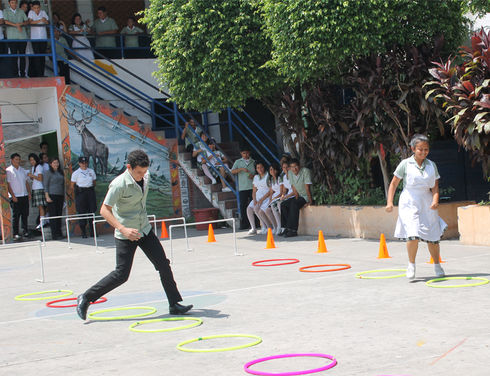
Donaldo González and Yancy Yamileth Ayala, both 16, compete in an exercise featuring colored hula-hoops, which is part of the Athletic Kids program offered through the School Police Program at El Salvador’s San Luis Institute. (Gloria Cañas / ISH)
Lorena Baires / ISH
November 12th, 2013 (ISH) Central America is seeking new strategies to protect schools from the violence committed by gangs, which has contributed to the academic failure of about 3.6 million children each year.
At the primary school level, 32.7% of Central American students drop out or repeat a grade. In high school, the figure rises to 69.2%, according to the report “Finishing School in Central America: The Pending Challenges” by the United Nations Children’s Fund (UNICEF).
Of the eight countries analyzed in the report, Belize retains the highest percentage of students in primary school, with 86%, followed by the Dominican Republic (83.7%), Costa Rica (81.9%), Panama (81.2%), El Salvador (64.7%), Guatemala (52.5%) and Nicaragua and Honduras (44.3%).
In Honduras, students endure harassment, extortion and attacks by gangs.
About 7,315 young people under the age of 23 were murdered between March 1998 and March 2012 in Honduras, according to a study by the international organization Casa Alianza.
Casa Alianza provides educational, cultural and athletic activities, as well as legal and healthcare assistance, to children and young people regionwide.
In the middle of last year, the fear of death surrounded a school in the municipality of Choloma in the department of Cortés, the second-most violent in the country.
“One of my students was kidnapped at the gate of the school. They tied him up and took him away in a car,” said a teacher whose named isn’t disclosed for safety reasons. “Other children saw where he was taken. They told us, and a group of teachers went to free him. They handed him over to us, beaten.”
To prevent cases like these, the Honduran Department of Education and the International Committee of the Red Cross (ICRC) in 2011 introduced the program “Creating Humanitarian Spaces” (CHS).
The CHS program is being carried out in 20 schools in the departments with the highest rates of violence – Atlántida, Colón, Copán, Cortés and Francisco Morazán.
Students, teachers, administrative personnel and community leaders are learning strategies focused on prevention, protection and assistance in cases of violence.
In the area of prevention, educational materials have been developed on humanitarian principles and values. To ensure protection, risks are evaluated and security measures are implemented at each school. In terms of providing assistance, training is provided in first aid and urgent emotional care.
“Though we were able to rescue the child, after the CHS training we realized the role we played: We put his life and ours at risk,” a teacher who took part in the student’s rescue in Choloma told ICRC professionals.
Maritza Amaya, a Honduran Department of Education official, said the program is a pedagogical approach to preventing and mitigating the risks and consequences of organized violence, which prevents the normal functioning of school life.
“CHS contributed to raising awareness and generating humanitarian behavior, as well as a respect for life and efforts to protect it,” Amaya said.
Laura Díaz, an ICRC representative in Honduras, said that in the 20 schools where the initiative has been implemented, the process has facilitated interaction between the school and the community and generated initiatives with preventive dynamics that hadn’t been planned by the program.
“The goal also is to create learning communities that extend beyond the classroom,” she said. “For example, at one school the parents organized, with the support of the Red Cross and the municipal government, a fair focused on the consequences of organized violence on young people and schools.”
Teaching values through sports
In El Salvador, in addition to school dropouts, dozens of students die and others are injured in gang-related incidents.
Forty-eight students have been killed in violent incidents outside of school nationwide this year after 78 died in 2012 and 180 in 2011, according to the National Civil Police (PNC).
José Guido, the director of the Alberto Masferrer National Institute (INAM), which is in the neighborhood of Zacamil in the western region of the municipality of Mejicanos, confirmed students have dropped out after receiving threats from criminal groups.
“To be honest, these young people are being threatened because their relatives are connected with gang violence,” he said.
To support the threatened students, the PNC in 2010 introduced the School Police Program, which assigns pairs of officers to schools to provide psychological care, give preventive talks to students in problematic situations and offer sports classes.
Last year, the National Sports Institute (INDES) provided training to 400 police officers to help them give guidance to students in 300 public schools through sports, according to Inspector Blanca Lidia Figueroa, the head of the PNC’s Youth and Family Services Division.
The officers work with schools and provide a one-hour class to about 40 students. Through sports, officers seek to strengthen values such as solidarity, companionship, honesty, respect and tolerance. At the end of the activity, students are asked to provide a summary of what they learned.
“Sports allow us to avoid conflict with the students because they see the police are taking a different approach. We focus on synergy and fill an open space that has been left by others,” Figueroa said.
The police’s leadership inside schools has exceeded the expectations of students.
At the Antiguo Cuscatlán National Institute (INAC) in the department of La Libertad, some of the students were involved in the sale and consumption of drugs. Through the assistance of the PNC, students said they are no longer involved with drugs.
“Many of my classmates have stopped taking and selling drugs because the talks and psychological therapy sessions have shown us that life is over pretty quickly for drug users,” said Alexander Castillo, one of INAC’s 844 students.
The PNC has dealt with cases where the school’s directors or teachers were reluctant to participate in the initiative because of a gang presence in the classroom. But Figueroa insists the program has helped students strengthen their values.
“The more we’re there working with conviction and leadership, the lower the levels of violence,” she said.

ATTENTION: If you are seeing this message,

