


Liberty Reserve founder says he was arrested after refusing to provide source code to FBI
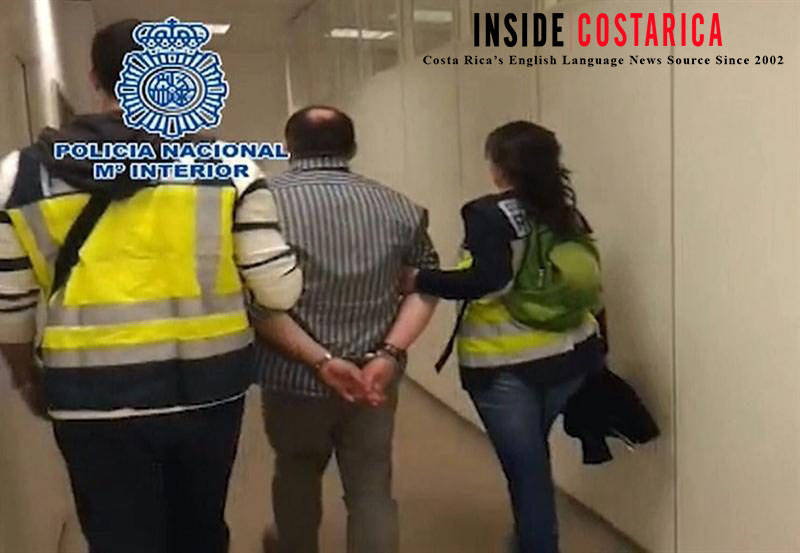
Budovsky escorted by Spanish authorities after his arrest in May.
January 28th, 2014 (InsideCostaRica.com) Arthur Budovsky, the man U.S. authorities accuse of being behind the “largest money laundering operation in history” told a Spanish court on Monday that he was arrested after refusing to disclose key technical details of his online operation to the FBI.
United States authorities have described his former company, Costa Rica-based Liberty Reserve, as the “largest money laundering operation in history,” and claim the online currency transfer business laundered more than $6 billion in illicit funds linked to everything from child pornography to online pharmacies.
On May 24, 2013, Spanish police arrested Budovsky as he stepped off a flight from Morocco to change planes en route to Costa Rica. The arrest came after a joint investigation between Costa Rican and United States law enforcement agencies.
On Monday, Budovsky acknowledged founding Liberty Reserve in 2006, but said he sold his share in the business the following year and was kept on only as a consultant.
Budovsky also said Liberty Reserve co-operated with the FBI and other international law enforcement bodies in Britain, France, and Spain when the system detected suspicious transactions.
Budovsky said his problems began in 2011, when the FBI asked him for the source code of the software that powered the online currency transfer business. Budovsky suggested that U.S. authorities wanted to use it to undermine his business, the Associated Press reported.
“I refused. It’s like asking Coca-Cola for their secret formula,” he told the court through an interpreter. “The truth is that the U.S. wants to protect its monopoly on financial transfer platforms.”
Budovsky said that the confiscation of Liberty Reserve’s servers allowed the United States to access financial information on some 800,000 users and 44 million transactions.
He also suggested that his decision to renounce his U.S. citizenship may have labeled him a “traitor” and played a role in his arrest.
Budovsky’s lawyer argued that the evidence presented by the U.S. prosecutor would not be sufficienti to open a case in Spain. The European Convention on Extradition demands that the alleged offence must be a crime in both countries.
Spain’s judiciary will decide on Budovsky’s extradition in the coming months, a ruling which will then have to be ratified by the government. If Spain declines to extradite Budovsky, he will be freed, as he faces no charges in Spain.
Full coverage of the Liberty Reserve case can be found here.
Related articles


ATTENTION: If you are seeing this message,
- expatin paradise
- CRChris
- expatin paradise

