


Work on Nicaragua Grand Canal to begin in December, completed in 2019
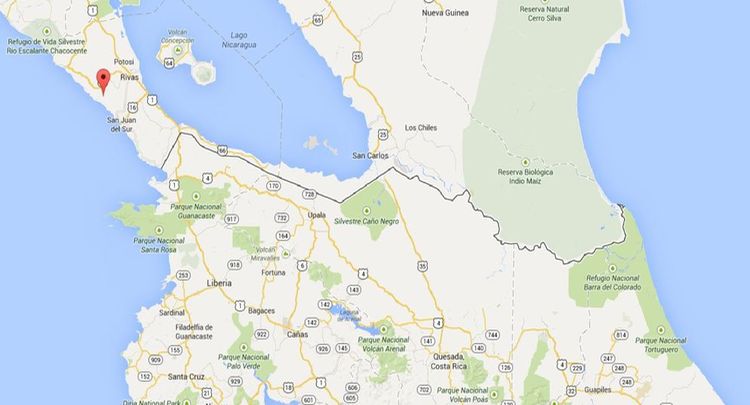
The route will begin at the mouth of the Brito River, indicated by the red marker. (Google Maps)
September 9th, 2014 (InsideCostaRica.com) The construction of the Interoceanic Canal of Nicaragua, also dubbed the “Nicaragua Grand Canal,” will begin in December and be completed by 2019, Telémaco Talavera, a member of the Grand Canal Commission, told the EFE news agency in recent days.
Talavera said that construction would begin with the necessary ports. On the Pacific side, the route will begin at the mouth of the Brito River in the Rivas department.
In total, the project includes two ports, an airport, an artificial lake, two locks, a free trade zone, tourist facilities, roadways and cement factories. The canal route will be three times longer than that of the Panama Canal.
The canal would be able to accommodate ships up to 400,000 tons.
The $40 billion USD project is expected to create 50,000 direct jobs and 200,000 indirect jobs.
Costa Rica in July expressed its concerns over the project’s possible environmental impacts, demanding environmental impact studies and assurances that the canal would not affect the flow or navigability of the San Juan and Colorado rivers.
“Costa Rica expects Nicaragua to send cross-border environmental impact studies and any other relevant technical studies, before any work begins, stating that [the canal] will not affect Costa Rica,” Costa Rican Foreign Minister, Manuel Gonzalez said in a note to his Nicaraguan counterpart in July.
Costa Rica also expressed its concern over accidents such as spills from oil tankers traversing the canal.
Concerns have even been raised in Nicaragua, where environmentalists and even some Nicaraguan politicians have questioned the project’s potential impact on the environment and the lack of experience of its Chinese developer with large infrastructure projects. Environmentalists are especially concerned because the canal will affect Lake Nicaragua. With an area of 8,264 square kilometers, the lake is the largest in Central America and an important source of fresh water.
The Chinese developers of the canal said last year that “Nicaragua will become by far the richest country in Central America [as a result of the canal] – and that will affect the entire region.”

ATTENTION: If you are seeing this message,
- Ken Morris
- disgusted
- Ken Morris
- K Schnelle
- Frank Castle
- Ken Morris
- Frank Castle
- Ken Morris

