


Costa Rica study shows slow-motion movements predict strength of future earthquakes
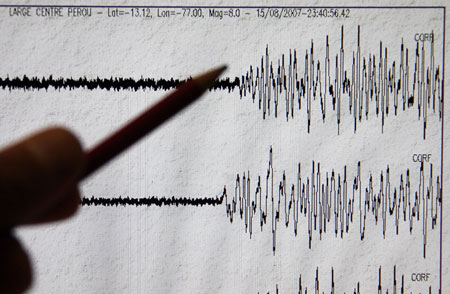
Archive image
By Art Chimes
November 20th, 2014 (VOA) Scientists know where earthquakes are likely to occur, but not when. Now, however, an American geologist and his team have found that it may be possible to at least forecast how strong a future earthquake may be.
The Earth’s crust is made of a mosaic of tectonic plates that move slowly, sometimes sliding under one another. Where that happens – it’s called a subduction zone – earthquakes can occur.
“They’re the kind of earthquake that made the big Japan earthquake in 2011 and the Sumatra earthquake and tsunami in 2004. So they can be, they can be the real killers,” says Timothy H. Dixon, PhD, a geologist at the University of South Florida.
He and his colleagues are using high-precision GPS measurements to detect “slow-slip events,” sort of slow-motion earthquakes that can’t be felt or even detected by standard instruments.
“So what we think these slow-slip events are telling us is, they’re letting off steam, so to speak, in areas of the fault. And if they let off enough steam, that part of the fault won’t rupture,” he explained in a telephone interview.
That’s key, because the more of the fault that ruptures, the more powerful the earthquake is.
The scientists set up a network of GPS receivers 15 years ago in Costa Rica to measure the occasional slow-slip events, which take place only every year or two. The last one was three months before the powerful 7.6 magnitude earthquake that struck Costa Rica on September 5th, 2012.
People always want to know when an earthquake is going to happen, and this technology can’t predict that. But Dixon says knowing how strong the earthquake is likely to be gives officials time to upgrade building codes, reinforce infrastructure, and make other preparations.
“You know the earthquake is more-or-less inevitable. Even if you don’t know exactly when it’s going to happen, since you know it’s going to happen, and you know how big it’s going to be, you can prepare accordingly,” he said.
He adds that other earthquake-prone subduction zones could benefit from this technology. But for now it can only be used in places where the zone is not too far offshore, because GPS receivers need to “see” satellites overhead, and they can’t do that underwater.
A scientific paper presenting Dixon’s findings is published in the Proceedings of the National Academy of Sciences.

ATTENTION: If you are seeing this message,

